Have you ever had a piano student who just didn’t get the grand staff? Whether it’s because of misinformation or misunderstanding – some kids seem to see music notation as an unsolvable mystery.
Chances are there at least a couple of students in your music studio right now who are desperately in need of some new note reading strategies.
You may have received transfer students who were taught using questionable methods. Or you may have long term students of yours who are still getting that deer in the headlights look when it comes to note names and reading.
Help your students recover from grand staff bafflement with these note name teaching ideas.
(And if the first one doesn’t work…come back and give one of the other twelve a try.)
Note Reading Immersion
When you need to push your students over the note name hill, what you want is grand staff immersion. Blanket them in note names with these gameified note reading strategies.
60 Second Challenge
The 60 Second Challenge is a favourite in my piano studio. Students name the notes as fast as they can to gain bronze, silver or gold levels. Get all the info on how I do this and the free printables for the 60 second challenge here.
iPad apps
There are so many iPad apps out there now that it can be hard to choose which ones to recommend to my students. My current favourites, however, are:
Let me know your favourite note naming apps in the comments, I’m always looking for new ones to try.
Note Naming Blitz
A cheeky, fun name for asking your student to name every single note before she plays her piece. This step is included in several of the practice step stickers that you can find here.
Stick at it, it will pay off in the end.
Theory Workbooks
My own Thinking Theory workbooks take the landmark approach to note names. For students who are having a hard time with the grand staff, I would also be supplementing with the Thinking Theory Plus books for extra review.
Grand Staff Perspectives
There are many different angles to view the staff from and your weak note reader is probably seeing it from a funny direction. Change their outlook to flip the switch on their grand staff confusion.

Landmark Notes
If your student started out using a different note reading method, introduce her to the landmark notes and help her find her way around using them. Review the landmark notes using the free Landmark Xs and Os game here.
I’ll actually be releasing a new free Thinking Theory video for the landmark notes this Thursday – subscribe to the newsletter (on the right) to make sure you don’t miss that.
Mnemonics
I know, I know. We’re all moving away from mnemonics these days. But if your student isn’t catching on using other methods, it might be worth a try.
After all, ultimately we want instant recognition anyway so sometimes needs must. I learned using mnemonics myself – and I think I turned out OK. 😉
Grand Staff Navigation
You might be surprised by what your student is NOT seeing the way you think they are. Review the difference between lines and spaces using this free worksheet here or using the Thinking Theory Prep Book and Thinking Theory Prep Book Plus.
Whiteboard
The whiteboard can open up so many possibilities for exploring the grand staff. If you don’t have one already just pick up a mini one at a dollar store and start quizzing and exploring at a mile a minute.
Videos
There are some videos out there that explore the grand staff and note identification. Piano Anne made this really fun series a while back using animation to explain the clefs and landmark notes.
The Thinking Theory video for the landmark notes will be out this Thursday – subscribe to the newsletter (on the right) to make sure you don’t miss that and all the other music theory videos coming soon.
Floor Staff
Setting up a floor staff is a wonderful way to get inside the grand staff. Plus the kids love it, especially at group lessons. Get ideas for games and see what my floor staff looks like here.
Piano Puzzle
These piano puzzle cards are one of my most popular resources. And with good reason! Making that direct connection between the staff and the piano keys is so important for confused music students. Seeing all the notes laid out like that can be just the ticket for kids to see the internal logic of the grand staff and understand how it works.
Click here to download the piano puzzle cards and see how I use them.
Sleuth Style Note Naming
With a resistant note reader, you may need to go incognito. Disguise note reading strategies and music theory in shrouds of fun and creativity – and you might break through the bewilderment to find note name clarity.
Composing
If you get students composing (and don’t act as their amanuensis) then they will have to way to write down their compositions. And if they have to write the notes, they need to work out where to put them.
Use the Animal Menagerie composing project to incorporate some undercover music theory in your studio. Your students won’t have any idea of your secret agenda.
Quick Studies
Sometimes what students need to become better readers and note namers is just more reading. Start assigning your students quick studies along side their regular repertoire.
Ideally quick studies should be a few levels below your student’s current repertoire – aim to have them completed in just one week of practice.
Note Naming Games
Music theory games are the ultimate in covert note reading strategies. Find the perfect music theory game for your student’s reading level in my Vibrant Music Teaching library.
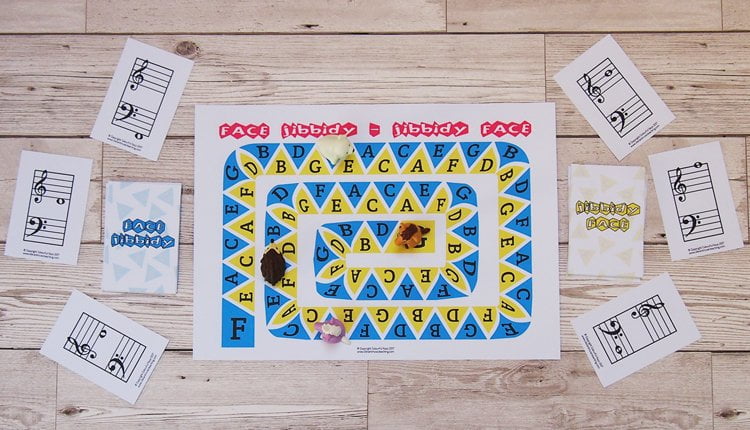
The library is all about games that really work. They take the hard job of drilling with a struggling student and help them to truly understand the staff, while having FUN.
Join today and see what games could do for you.
Tell me your top note reading strategies!
What’s your favourite way to approach the grand staff with a struggling reader? What do you do when a piano student just doesn’t catch on to note reading?
Hi
I love your board because music is a huge part of my life too. The iPad app music tutor is good for music students. May God bless you in all you do.
Glad we could share a love of music Rhea!
Hi Nicola! You mentioned a free worksheet under “Grand Staff Navigation,” but there is no link… I would love to check it out if it is still available! 🙂
Fixed Karissa, thank you
I have a few students who use the piano puzzle cards and they love trying to beat their time. Aside from being an awesome learning tool, I love that they look so sharp on fun foam .
Haha, I appreciate a nice clean edge too! 😀
Nicola, Method books often introduce a note at a time. Do you have any recommendations on teaching the Grand Staff all at once as a system to students? (Of any age, but right now I am especially thinking of my youngest students who are ages 6 and 7.)
I recommend taking a look at how Piano Safari does this in book 2.